

Industrial work platforms: what the 2024 IBC's Sections 2212 and 2213 changed
The 2024 IBC gave industrial steel work platforms their own section and design standard, ANSI MH28.3. What that changed, what it didn't, and where it is law.
Editorial & Engineering Team
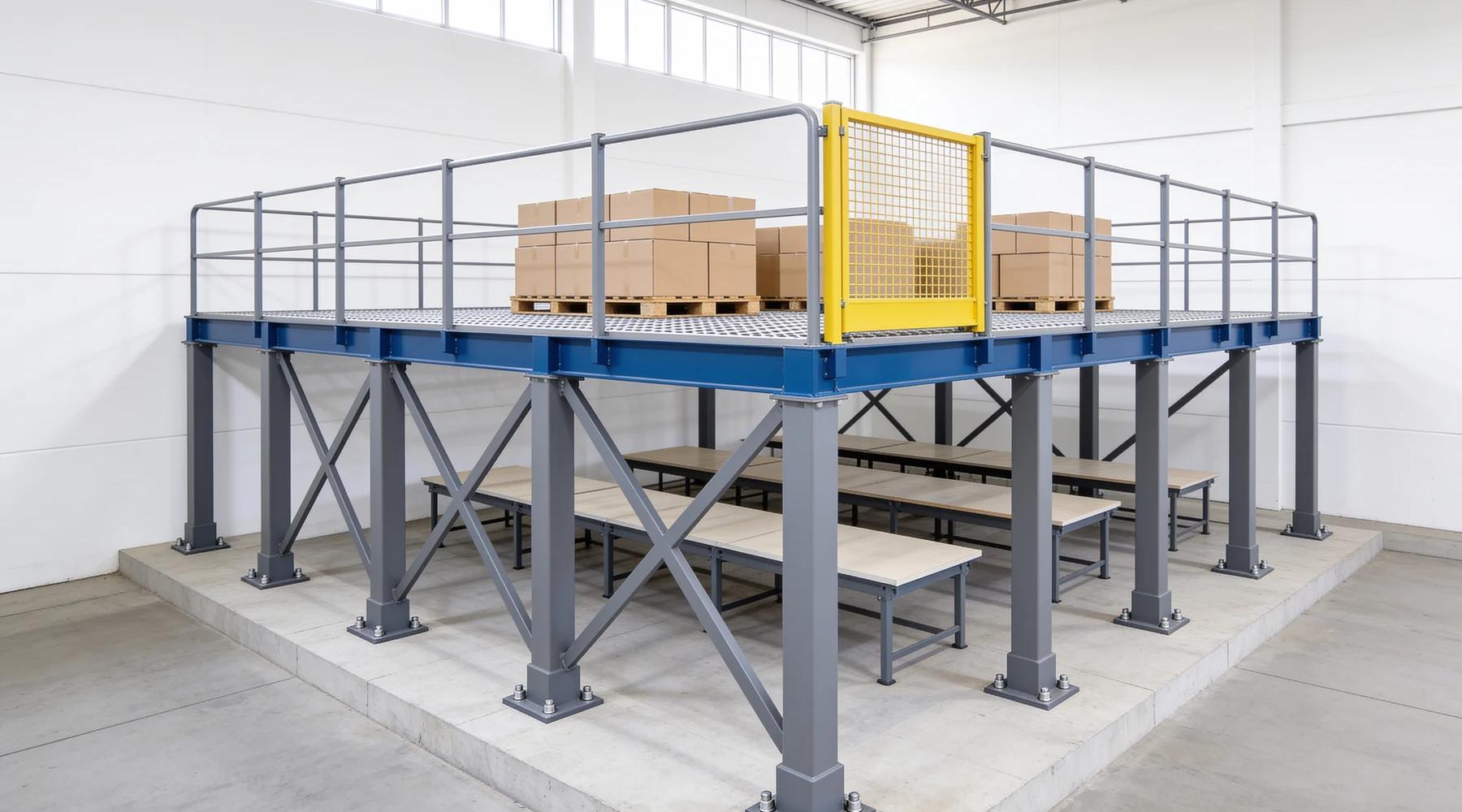
Until the 2024 edition, the International Building Code had nothing to say about an industrial work platform by name. A free-standing steel deck bolted to a warehouse slab was designed to whatever the engineer and the plans examiner agreed on. The 2024 IBC changed that with two short new sections, and both point to industry standards rather than to the code's own mezzanine rules.
This article covers what those two sections say, what they leave out, and where they are now law. Our mezzanine vs work platform vs catwalk comparison covers the three categories in everyday terms, and our prefab mezzanine guide covers the shop-fabrication side of the same standard. This one reads the code text itself.
What changed in the 2024 IBC for work platforms?
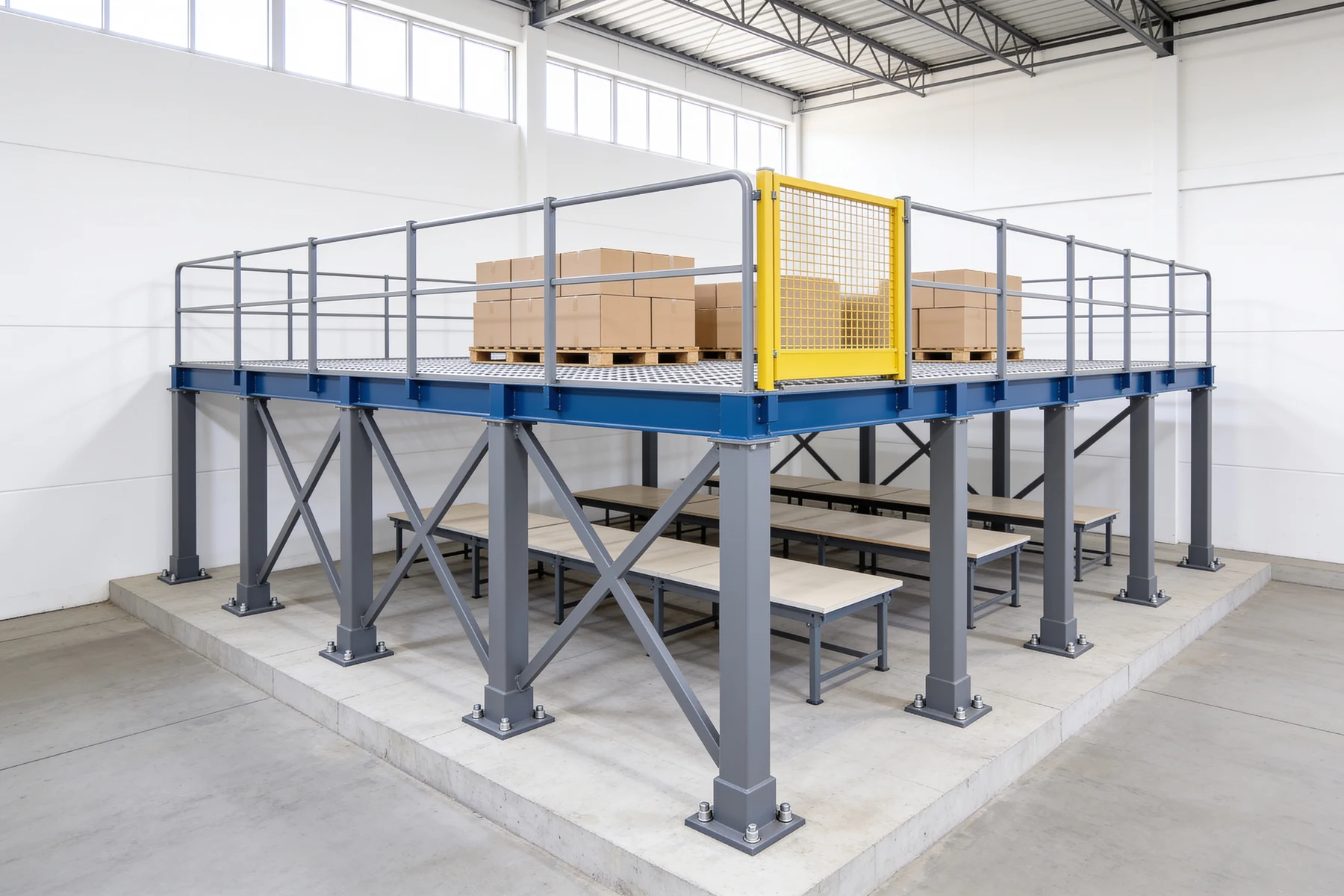
The 2024 IBC added two new sections to Chapter 22: §2212 sends industrial steel work platforms to ANSI MH28.3, and §2213 sends their stairs, ladders and guards to ANSI MH32.1. Neither section appears in the 2021 IBC, so both apply only where the 2024 edition has been adopted.
The 2021 edition's steel chapter, as adopted in Alabama's 2021 building code, runs from §2201 to §2211 and says nothing about work platforms, MH28.3 or MH32.1. ICC's own 2024 IBC structural-changes seminar slides list both as newly created sections. The 2024 IBC Chapter 35 reference list pins the editions: ANSI MH28.3-2022 and ANSI MH32.1-2018.
The change came through the 2022 ICC Group B cycle. MHI filed proposal S193-22, arguing that the Storage Manufacturers Association (SMA) developed MH28.3 with FEMA's Seismic Code Support Committee and that it was already the industry's standard in use (ICC Group B proposals, p. S503). The structural committee approved it as modified, 12–0, and moved it into its own section.
What does IBC Section 2212 actually say?
Section 2212.1 is two sentences. It requires that the "design, testing and utilization" of industrial steel work platforms follow ANSI MH28.3. It also requires seismic design to ASCE 7 Chapter 15 wherever ASCE 7 calls for seismic design.
That is the whole section, as shown in the Utah 2024 building code viewer. The same text appears unamended in the Oregon, New York, New Jersey, Nevada and New Hampshire 2024 viewers. Three things are worth noticing:
- "Utilization" reaches past design day. The requirement covers how the platform is used, not just how it is built. That matters for the owner's inspection and maintenance duty.
- The code never defines the term. The 2024 IBC Chapter 2 definitions have no entry for "industrial steel work platform." The working description comes from the standard. MHI's standards catalog (p. 16) describes a typically prefabricated, free-standing non-building structure with an elevated surface on a pre-designed framing system, located in an industrial or similarly restricted environment.
- Seismic is sent past the standard. Where ASCE 7 requires seismic design, §2212.1 names ASCE 7 Chapter 15 directly, the same pattern the 2024 code uses for industrial boltless shelving in §2211.
MH28.3-2022 was approved February 1, 2022, replacing the 2018 edition. MHI's announcement quoted SMA's standards chair saying that the main update was guidance for high-seismic areas. The ANSI webstore sells the 2022 edition for $58, and its abstract says the standard covers design, manufacturing, installation and maintenance. We have not obtained the 2022 text, so no clause from it is quoted here.
What does Section 2213 add for stairs, ladders and guards?
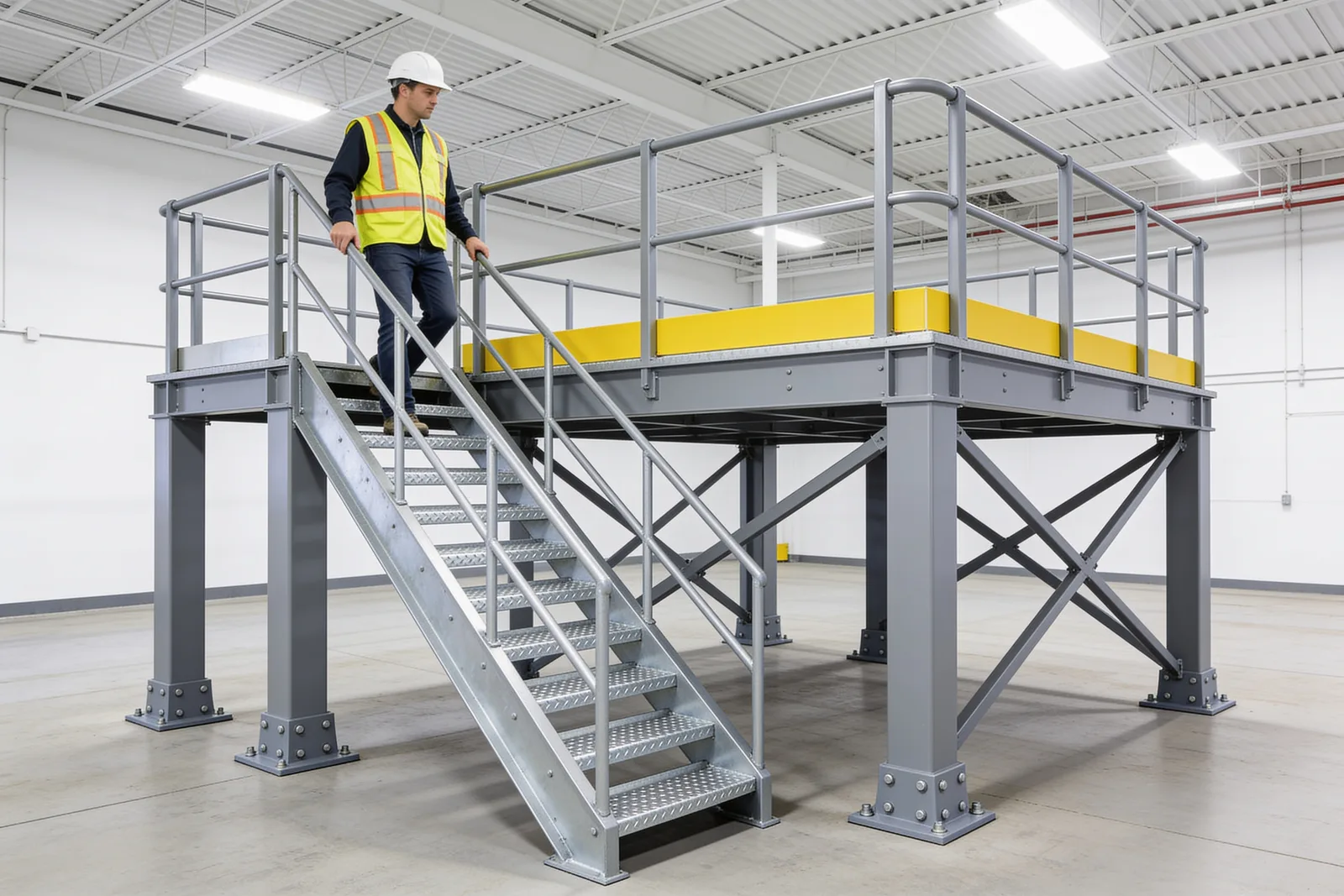
Section 2213.1 requires that stairs, ladders and guarding serving storage racks and industrial steel work platforms "used in material handling structures" be designed and installed to ANSI MH32.1. That qualifying phrase keeps the section narrow.
The phrase was added late in the process. Public Comment 1 on proposal S192-22 argued that without it, every steel-framed platform, HVAC service decks included, could be pulled under MH32.1 (ICC 2022 public comment agenda, pp. 704–705). The proposal's stated reason was to put OSHA and building-code access-way rules into one document. Its cost statement noted that some jurisdictions had been applying Chapter 10 means-of-egress rules to employee-only access ways (proposals, p. S502).
STRUCTURE magazine's review of the 2024 changes gives the practical boundary. Guards on a steel platform that services HVAC equipment still follow IBC §1607.9, and its stairs still follow the IBC, not MH32.1. MHI's catalog lists MH32.1's scope as stairs, ladders and guards on pick modules, decked-over platforms and free-standing work platforms. It excludes roof access, conveyor crossovers and AS/RS. For the IBC and OSHA stair rules that apply everywhere else, see our mezzanine stairs guide.
Is an industrial work platform the same as an equipment platform?
No, at least not in the code text. The IBC defines an equipment platform as unoccupied and used exclusively for mechanical systems or industrial process equipment. A platform carrying stored goods or pickers does not obviously qualify, and §2212 never links itself to §505.3.
This is the confusion that costs money. Several manufacturer pages treat "work platform" and "equipment platform" as synonyms and then claim the equipment platform's larger area allowance. The code's own numbers, from 2024 IBC §505:
| Mezzanine (§505.2) | Equipment platform (§505.3) | Industrial steel work platform (§2212) | |
|---|---|---|---|
| Defined in Chapter 2? | Yes | Yes, as unoccupied and equipment-only | No |
| Area cap in the room | One-third (two-thirds or one-half under listed exceptions) | Two-thirds, combined with any mezzanine | None stated in §2212 |
| Counts toward fire area | Yes | No | Not addressed |
| Means of egress | Chapter 10 applies (§505.2.2) | Its stairs and ladders may not serve as building egress | Not addressed |
| Design standard | General structural chapters | General structural chapters | ANSI MH28.3 |
Equipment platforms also may not be part of a mezzanine, and in a building required to be sprinklered they must be protected by sprinklers above and below. The two-thirds cap was already in the 2021 edition, so it is not a 2024 change. For the one-third rule itself, see our IBC 2024 mezzanine requirements guide.
Does Section 2212 exempt a work platform from mezzanine rules?
Nothing in §2212 says so. The section sets a design standard. It grants no exemption from §505, from the Chapter 10 egress rules or from Chapter 11 accessibility, so the classification question still goes to your building official.
Industry sources disagree on how to frame it. The Rack Manufacturers Institute (June 2026) quotes a Steel King engineer describing work platforms as free-standing retrofits "considered equipment," while mezzanines are tied into the building's columns. MHI and STRUCTURE describe the platform as a non-building structure. None of these is code text.
The label matters because accessibility rules key on the word "mezzanine." 2024 IBC §1104.4 requires an accessible route to each mezzanine, with an exception for an aggregate area of 3,000 sq ft or less, subject to carve-outs. RMI reports a project where drawings labeled a work platform as a "mezzanine," and the AHJ required an elevator late in approval. Our permit requirements guide and the permit lookup tool cover how to raise the question early.
How do work platforms compare with storage racks at plan review?
Storage racks 8 ft or taller in Seismic Design Categories D–F need a certificate of compliance and periodic special inspection under the 2024 IBC. Industrial steel work platforms carry neither requirement in the code text.
| 2024 IBC provision | Steel storage racks | Industrial steel work platforms |
|---|---|---|
| Design standard | ANSI MH16.1 (§2209.1) | ANSI MH28.3 (§2212.1) |
| Certificate of compliance to owner | Required, ≥8 ft in SDC D–F (§2209.3) | Not required |
| Special inspection | Periodic, ≥8 ft in SDC D–F (§1705.13.7) | No mention |
| Stairs, ladders, guards | ANSI MH32.1 (§2213.1) | ANSI MH32.1 (§2213.1) |
Sources: 2024 IBC Chapter 22 and Chapter 17. "Platform" does not appear anywhere on the Chapter 17 page. Note also that the 2024 IBC definition of a steel storage rack includes rack-supported platforms. A deck carried on rack uprights therefore stays under §2209 and MH16.1, not §2212. Our MH16.1 vs IBC guide covers that path.
One non-code signal is new. In August 2026, Steele Solutions announced that it was the first manufacturer to earn SMA Certification for industrial work platforms. The program is based on third-party review of calculations, product testing and quality systems against MH28.3. It is voluntary and industry-run, not a code requirement.
Where is Section 2212 now law?
Only where the 2024 IBC is adopted. Utah's adoption took effect July 1, 2026, Oregon's 2025 structural code on October 1, 2025, New York State's on December 31, 2025, and New Jersey's on August 17, 2026.
| Jurisdiction | Adopted code | Effective | Source |
|---|---|---|---|
| Utah | 2024 IBC | July 1, 2026 | HB 65 (2026), enrolled |
| Oregon | 2025 OSSC (2024 IBC base) | Oct 1, 2025, six-month phase-in | Oregon BCD |
| New York State | 2024 I-Codes | Dec 31, 2025 | ICC release |
| New Jersey | 2024 I-Codes in the UCC | Aug 17, 2026 | Jensen Hughes code alert |
UpCodes lists many more jurisdictions on the 2024 IBC, including California, Colorado, Georgia and Illinois, but without effective dates, and local amendments can change the text. Confirm the edition with your building department.
What does ANSI MH28.3 not cover?
By its own scope, MH28.3 does not address snow, wind or rain loads. It applies only to steel-framed platforms, and it assumes users are trained workers in a restricted area. Anything outside that scope needs a qualified design professional.
STRUCTURE's review states that such loads "are not addressed in this standard" (STRUCTURE, 2024), and MHI's catalog says outdoor systems need a qualified design professional's approval. A platform that complies with MH28.3 is therefore not automatically suitable for a canopy, dock apron or rooftop. The free ANSI preview of the 2009 edition shows the standard's chapter layout at that time: egress, guards, materials, loading, structural design, and quality and special inspections. We could not confirm whether the 2022 edition keeps the same structure.
What does OSHA add on top of the IBC?
OSHA regulates any elevated walking-working surface as a platform, whatever the building code calls it. Fall protection is required at 4 feet, and guardrail top rails must sit at 42 inches, plus or minus 3, and withstand 200 pounds.
29 CFR 1910.21(b) defines a platform as "a walking-working surface that is elevated above the surrounding area". The protection trigger is in 1910.28(b)(1)(i), and the rail height and 200-lb load are in 1910.29(b). The building code is stricter on the trigger: 2024 IBC §1015.2 requires guards on open sides more than 30 inches above the floor, and explicitly names mezzanines and equipment platforms. Our railing and guardrail guide covers where the two rulebooks differ.
The limits of this article
Everything above is adopted code text, federal regulation text, or a named organization describing its own standard or program. The full text of ANSI MH28.3-2022 and MH32.1-2018 was not obtained, so no load value, clearance or test requirement from either standard is stated here. Whether a given structure is a mezzanine, an equipment platform or an industrial steel work platform is decided by the building official, and the design must come from a licensed engineer. Treat this as a map of the code, not as advice on your project. The tax treatment of these structures is covered separately, and with the same caveats, in our mezzanine depreciation article.
What to read next
- Mezzanine vs work platform vs catwalk — the three categories side by side, in plain terms
- ANSI MH16.1 vs the IBC for rack-supported mezzanines — the parallel path when the deck sits on racking instead of its own columns
- IBC 2024 mezzanine requirements — the one-third rule, clear height and egress that apply once a structure is classed as a mezzanine
Put this guide into practice
Frequently asked questions
- What is an industrial work platform under the building code?
- The 2024 IBC names industrial steel work platforms in Section 2212 but does not define them in Chapter 2. The standard it references, ANSI MH28.3, describes one as typically a prefabricated, free-standing non-building structure with an elevated surface on a pre-designed steel framing system, inside an industrial or similarly restricted environment.
- What does IBC Section 2212 require?
- Section 2212.1 of the 2024 IBC requires that the design, testing and utilization of industrial steel work platforms comply with ANSI MH28.3, and that seismic design follow Chapter 15 of ASCE 7 where ASCE 7 requires it. It is a design-standard reference, not an exemption from other parts of the code.
- Is an industrial work platform the same as an equipment platform?
- Not in the code text. The IBC defines an equipment platform as an unoccupied elevated platform used exclusively for mechanical systems or industrial process equipment, and caps it at two-thirds of the room. A platform used for storage or picking does not obviously meet that definition, whatever a brochure calls it.
- Does a work platform need special inspection like storage racks?
- Not under the 2024 IBC as written. Section 1705.13.7 requires periodic special inspection for steel storage racks 8 feet or taller in Seismic Design Categories D through F, and Section 2209.3 requires a certificate of compliance for those racks. Neither provision mentions industrial steel work platforms.
- Is IBC Section 2212 in force in my state?
- Only where the 2024 IBC has been adopted. Section 2212 does not exist in the 2021 IBC. Utah's adoption took effect July 1, 2026, Oregon's 2025 code on October 1, 2025, and New York State's on December 31, 2025. Check your own jurisdiction's adopted edition before relying on it.
Continue planning your mezzanine
All Code & Permits guides →
Code & Permits
Mezzanine Fire Sprinkler Requirements: NFPA 13 Guide
Review mezzanine sprinkler requirements, below-deck obstructions and open grating. Understand the design questions to resolve with your fire-protection team.
Code & Permits
Mezzanine Permit Requirements: Drawings & Approvals
Prepare a mezzanine permit application: drawings, structural review, building codes and inspections. Find state resources and understand the approval process.
Code & Permits
IBC 2024 Mezzanine Requirements: Area, Height & Egress
Explore IBC 2024 mezzanine requirements for floor area, clear height, openness and egress, with links to stair, sprinkler and state permit guides.