

Mezzanine inspection and maintenance: the one-sentence federal duty, and what actually gets checked
OSHA's entire mezzanine inspection duty is one sentence, and it sets no interval. What the law requires, and the sourced criteria that decide pass or fail.
Editorial & Engineering Team
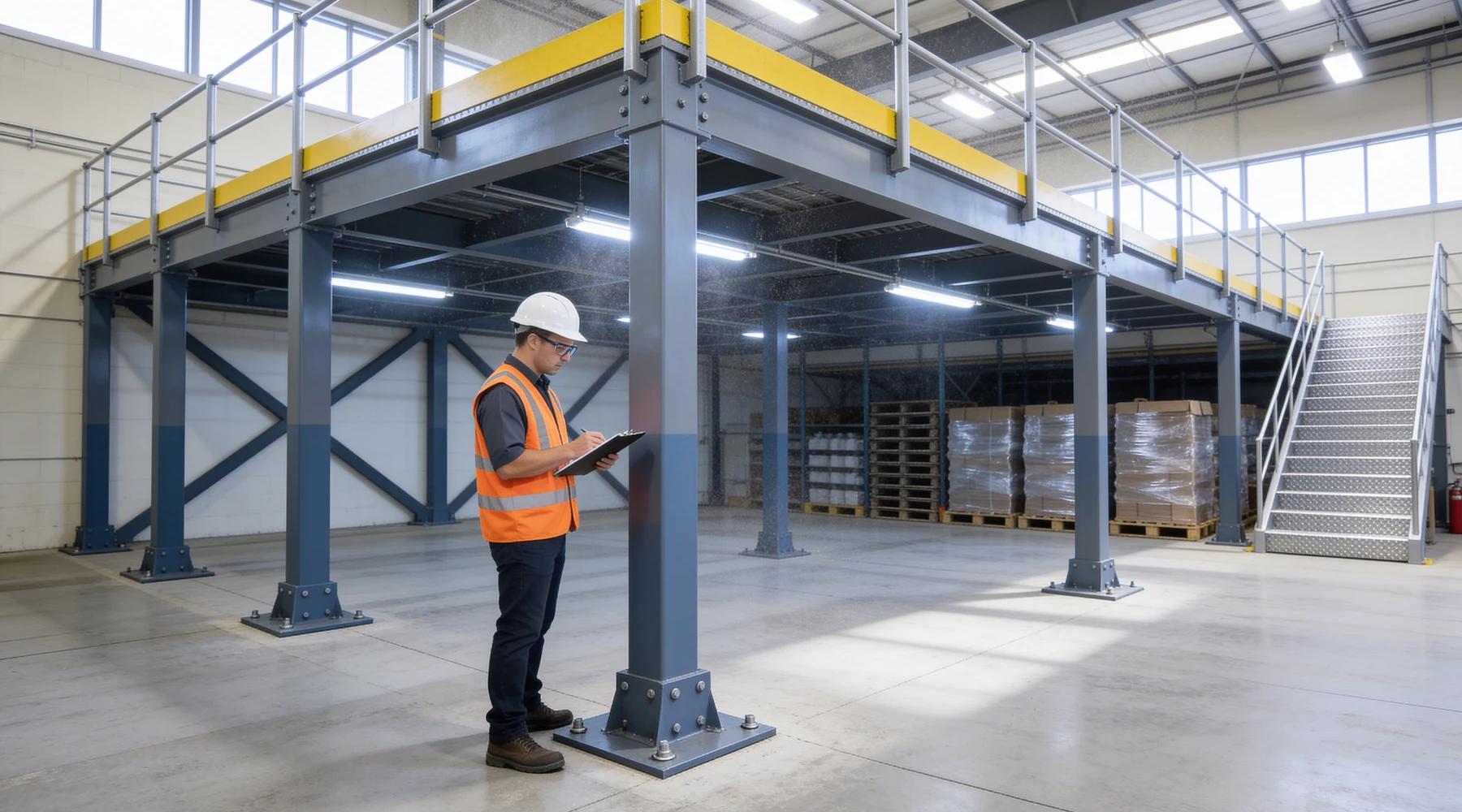
Search mezzanine inspection and page after page tells you OSHA requires an annual inspection. OSHA requires no such thing. The federal duty is real and it is mandatory — it is also exactly one sentence long, and that sentence contains no interval at all.
This article is about what the law actually says for a free-standing mezzanine or work platform, and about the published accept/reject criteria that decide whether the thing you are looking at is a defect or just a mark. Our pallet rack inspection guide covers the same duty where the structure is racking and ANSI MH16.1 governs; this one is about decks standing on their own columns. Our OSHA mezzanine requirements guide covers the guardrail, stair and egress rules themselves.

Is a mezzanine inspection legally required?
Yes. 29 CFR 1910.22(d)(1) requires that "Walking-working surfaces are inspected, regularly and as necessary, and maintained in a safe condition." That is the entire inspection mandate — and it names no frequency.
Two more sentences finish the duty. 1910.22(d)(2) requires hazardous conditions to be "corrected or repaired before an employee uses the walking-working surface again," and where repair cannot be immediate, "the hazard must be guarded to prevent employees from using the walking-working surface until the hazard is corrected or repaired." 1910.22(d)(3) adds that "When any correction or repair involves the structural integrity of the walking-working surface, a qualified person performs or supervises the correction or repair."
Worth knowing why no OSHA page seems to be about mezzanines: the word never appears in the walking-working surfaces rules. A mezzanine is regulated as a platform, which 1910.21(b) defines as "a walking-working surface that is elevated above the surrounding area," while a catwalk falls under runway — "an elevated walking-working surface, such as a catwalk, a foot walk along shafting, or an elevated walkway between buildings." That is the vocabulary the duty is written in, and our catwalk guide covers why the distinction changes the rules.
The building code is the opposite of what most people assume. The IBC imposes no periodic inspection duty on an existing mezzanine at all: §1704.2 special inspections run "during construction" only, and §116 Unsafe Structures is a reactive power of the building official. The standing maintenance duty lives in the property maintenance code instead — IPMC §304.4 requires that "Structural members shall be maintained free from deterioration, and shall be capable of safely supporting the imposed dead and live loads," and §305.4 extends that to "Every stair, ramp, landing, balcony, porch, deck or other walking surface." Neither sets an interval either.
How often should a mezzanine be inspected?
No US regulation sets one. The "weekly visual plus annual expert" schedule repeated across this industry is British guidance, written about pallet racking rather than mezzanines, and it is not compulsory even in Britain.
Its actual source is the UK Health and Safety Executive's HSG76, under the heading Racking inspection and maintenance: ¶645 says inspections should be made "at weekly or other regular intervals based on risk assessment," and ¶646 that "A technically competent person should carry out inspections at intervals of not more than 12 months." HSG76 also states its own status plainly — "Following the guidance is not compulsory and you are free to take other action." Three jumps happen before that reaches a US warehouse: jurisdiction, equipment, and legal force.
The market reflects the confusion. Across 28 pages ranking for this topic, 14 state a specific inspection interval and exactly one cites a source for it — a UK supplier that leads by admitting "there is no official regulation that states mezzanine floors are to be inspected." The recommended frequencies run from weekly to every two years, a hundredfold spread, and no page explains why its number differs from anyone else's.
For contrast, regulators write intervals when they mean to. The only shift-based interval anywhere in OSHA's Subpart D is for ladders — 1910.23(b)(9): "Ladders are inspected before initial use in each work shift." Cal/OSHA, the most prescriptive state plan in the country, requires skylight nets to be "inspected weekly by a competent person" — and sets nothing comparable for elevated platforms.
So "regularly and as necessary" is the standard, and the defensible answer is a frequency you can justify from risk: forklift traffic past column bases, actual impact history, wash-down or leak exposure, deck type, and any change in what the deck carries. Write down the reasoning, not just the date.
Who is qualified to inspect a mezzanine?
Note where the credential attaches. 1910.22(d)(3) requires a qualified person for the repair, not for the inspection. OSHA defines "Qualified" by degree, certificate, professional standing, or "extensive knowledge, training, and experience" with demonstrated ability to resolve problems in the subject matter.
In practice that splits the job. Routine looking is a trained-employee task. The moment a finding touches structural integrity, the correction has to be performed or supervised by someone meeting that definition — which for a bent column or a cracked weld means a structural engineer. ASCE/SEI 11, the standard for structural condition assessment of existing buildings, frames the same split as preliminary versus detailed assessment and requires that "Interpretation of results and conclusions shall be performed by a registered professional engineer qualified in the appropriate discipline." Its body text is paywalled, so treat that as the framework, not a procedure you can download.
The trade association doing the best public methodology work here is the commercial inspectors' body CCPIA, which advises starting with a macro view — "Look for deviations from plumb, level, square, or straight" — and adds the rule most checklists omit: "If any visible issues suggest compromised structural integrity, do not access the mezzanine."
What do you check on the steel and the bolts?
Start at the connections — and leave the torque wrench in the truck. Most free-standing mezzanine beam-to-column joints are snug-tightened, and the RCSC Specification §9.1 commentary is explicit: "Because pretension is not required for the proper performance of a snug-tightened joint, the installed bolts should not be inspected to determine the actual installed pretension."
What the spec asks you to verify instead is that "the plies of the connected elements have been brought into firm contact and that washers have been used as required." Torque is a poor proxy anyway — §9 commentary notes measurements "do not provide consistent results for inspection, as they are greatly dependent on the friction between bearing faces and threads," and AISC records that standard torque tables were withdrawn after installed tension was shown to vary "plus or minus 40 percent".
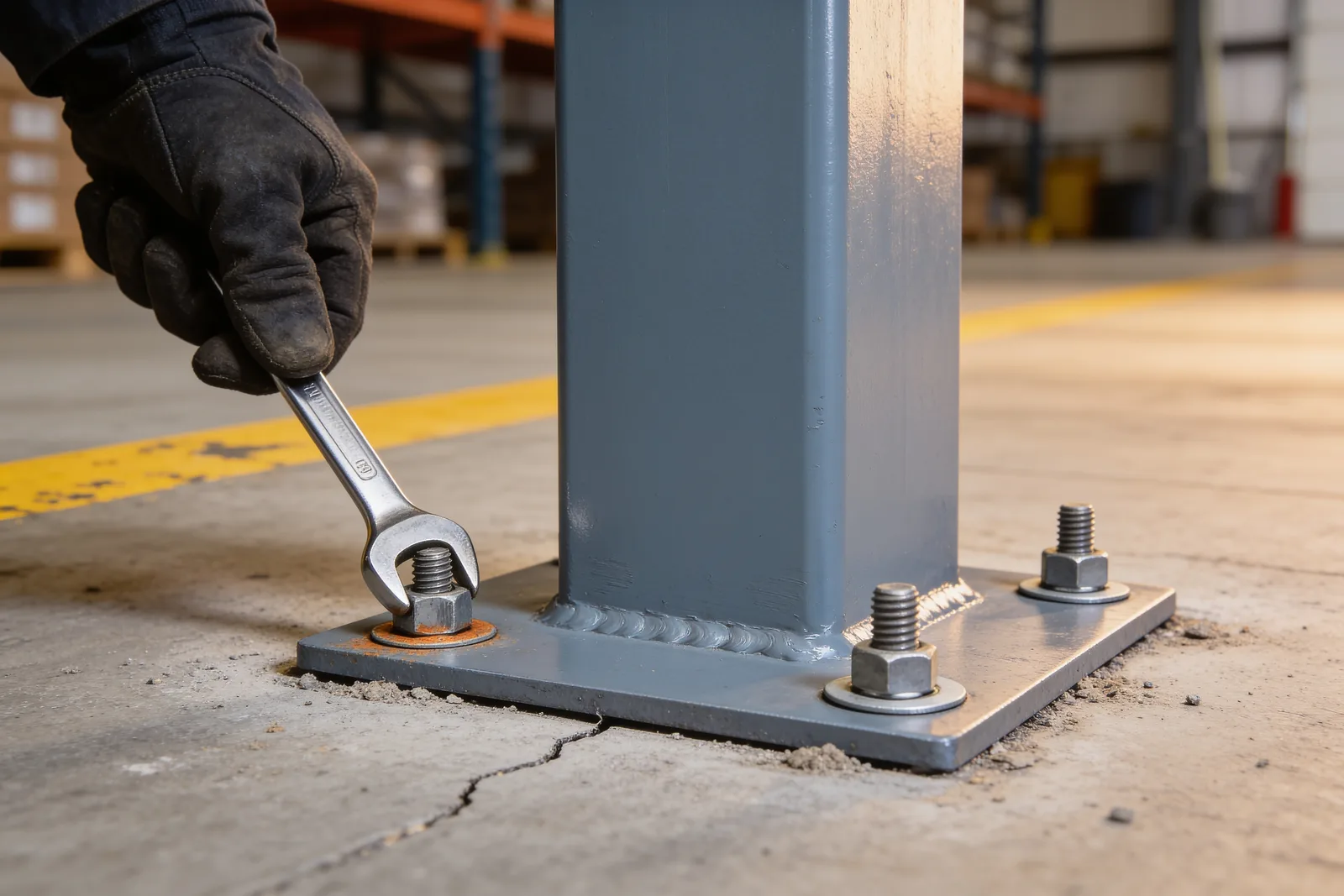
That reframes the most common checklist line on the internet. AISC states that "when properly installed, the high-strength bolt-nut assembly will not loosen," so a genuinely loose bolt is not normal service wear — it is evidence of an installation defect or of loading the structure was not designed for. Treat it as a finding to explain, not a nut to tighten and forget. One related trap during any reconfiguration: RCSC §2.11.2 states that "Galvanized or coated bolts of any Group or grade… shall not be reused," which covers most mezzanine hardware.
Three more criteria are worth carrying in your head:
- Plumbness. The erection tolerance for structural steel is ±1:500, so a 12-foot column may legitimately lean about 0.29 inch. Useful as a yardstick — but AISC also says, verbatim, that "Tolerances for assemblies—such as those on shop-assembled bents, frames, platforms, pairs of girders, etc.—are not covered by any code or standard." There is no published whole-mezzanine tolerance to fail something against.
- Gaps at bearing connections. AISC Specification §M4.4 permits "Lack of contact bearing not exceeding a gap of 1⁄16 in."; between 1⁄16 and 1⁄4 inch, the gap "shall be packed with non-tapered steel shims." The same allowance governs an ungrouted base plate.
- Deflection and bounce. IBC Table 1604.3 sets floor members at ℓ/360 live and ℓ/240 total — but read the section's own verb: structures "shall be designed" to those limits. They are design criteria, not damage thresholds. A deck measuring worse is a reason to call an engineer, not a verdict in itself. For a bouncy deck, AISC's free vibrations guide warns that floors under 3 Hz "should generally be avoided," and §10.2 advises measuring before designing any retrofit, because analysis assumptions "may not match actual conditions." Our floor design guide covers why mezzanines bounce more than ordinary floors.
Is that rust a problem, or just staining?
A magnetic coating gauge settles it in about a second. The American Galvanizers Association's field inspection guidance puts it directly: "To distinguish between red rust and brown staining, simply test the area with a magnetic thickness gauge. If the gauge reading shows a coating thickness, it is brown staining and the corrosion performance of the galvanized coating is not affected."
White powdery deposits on galvanized steel — wet storage stain — are similarly over-read. AGA's guide grades it: "Light and medium wet storage stain do not require cleaning nor effect the service-life of the zinc coating," heavy and extreme must be removed, and black staining means "a significant amount of zinc coating has been consumed" and the steel must be stripped and regalvanized. The reason it looks alarming is arithmetic — the corrosion products are "about three to five times greater than zinc metal." Where removal is warranted, AGA specifies a stiff nylon brush, explicitly not a wire one, with repair per ASTM A780.
For scrapes down to bare steel, AGA gives the threshold: zinc cathodically protects bare areas "between 1 mm - 5 mm wide depending on the electrolyte." Wider than that needs touch-up.
The most useful corrosion advice, though, is about where to spend the time. AISC's Specification commentary reports that unpainted steel framing in long-standing demolished buildings "has been found to be unchanged from the time of its erection, except at isolated spots where leakage may have occurred." On a dry enclosed mezzanine, corrosion inspection is really leak inspection — plus AGA's four problem geometries: crevices, dissimilar metals in contact, flat surfaces where water pools, and previously touched-up areas, which "often corrode more quickly than the surrounding zinc coating."
What about the deck, the guards and the gates?
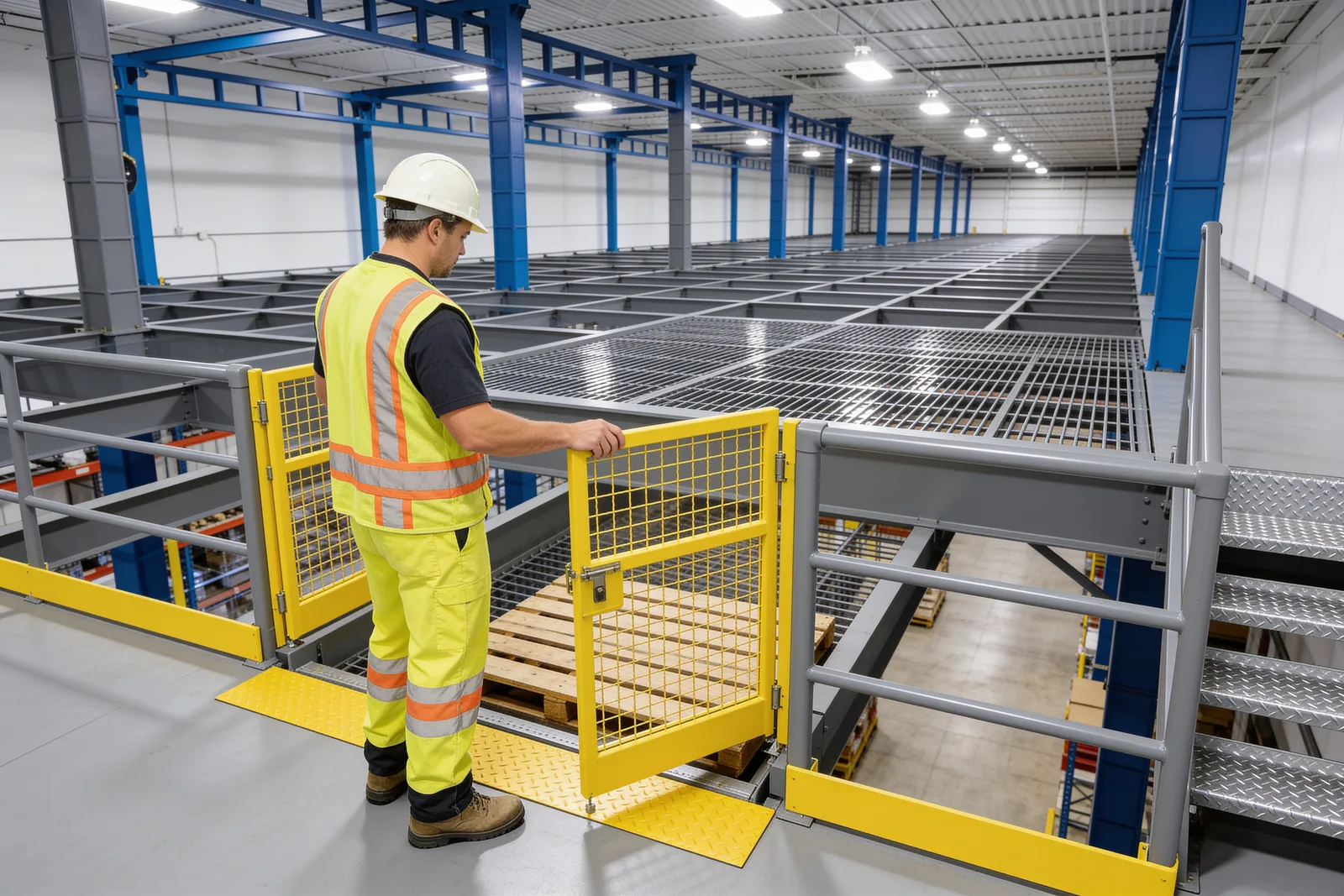
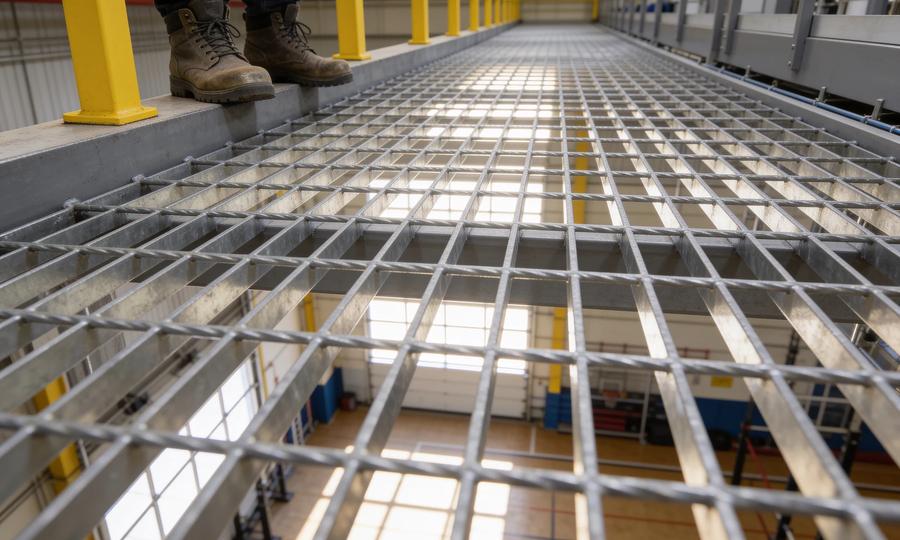
Bar grating is the one deck type with published in-service instructions. ANSI/NAAMM MBG 531 tells owners to "Periodically inspect grating to be sure that all grating is securely fastened," replacing missing hardware and tightening loose connections, and separately to check for "corrosion, damage to the finish, deformation and excessive bearing bar lean." It also gives a hard geometric criterion worth measuring on any reconfigured deck: a 1 inch minimum bearing surface for bar depths up to 2¼ inches and 2 inches at 2½ inches and over, at each end of span. Our bar grating guide covers the specification side.
On guards, the single most misquoted line in this subject is 1910.29(b)(4). It is a height floor, not a deflection cap: under the 200-pound test load "the top rail of the guardrail system must not deflect to a height of less than 39 inches (99 cm) above the walking-working surface." A 45-inch rail may deflect six inches and pass; a 39-inch rail may not deflect at all. Pages quoting "a deflection of no more than three inches" have invented it.
And the two rulebooks genuinely disagree, which is why the same deck can pass one inspection and fail another:
| The same mezzanine | OSHA, general industry | IBC 2021 |
|---|---|---|
| Guard required at | 4 ft — 1910.28(b)(1)(i) | 30 in — §1015.2 |
| Guard height | 42 in ±3 — a 39–45 in band, and may exceed 45 in | "not less than 42 inches" — a minimum |
| Load capacity sign | none; placard rule deleted in 2016 | required above 50 psf — §106.1 |
| Inspection interval | none stated | none stated |
A 39-inch rail complies with OSHA and fails the IBC. Our guardrail guide works through the rest of that divergence.
Gates are the one component where a manufacturer publishes real frequencies with pass/fail standards. The PS Industries SafeMezz maintenance manual schedules checks at each use, weekly and monthly, and sets the standards: welds "intact without visible cracks or crazing"; fasteners "present and be Snug Tight; connections pulled into firm contact by the fastener, no gaps between material" — the same snug-tight test as the structural steel. Its governing rule is the one to copy into any program: if an item fails, "IMMEDIATELY 'TAG OUT' the SafeMezz Pallet Gate removing it from active use and guard the opening until repairs are completed." See our safety gates guide for gate types.
When does a change of use force a re-analysis?
At a 5 percent load increase. The IEBC sets the threshold three times over — §502.4 for additions, §503.3 for alterations, and §506.5.1 for changes of occupancy. The additions wording: any existing gravity load-carrying element seeing an increase "of more than 5 percent shall be replaced or altered as needed to carry the gravity loads required by the International Building Code for new structures."
That is the rule nobody inspects against, and it is the one most often broken quietly — a vertical lift module, a conveyor run, a partitioned office, or racking added to a deck rated for palletized storage. Two specifics make it sharper:
- Anchors were not evaluated for the new duty. Hilti's ICC-ES evaluation report for a common wedge anchor states that because acceptance criteria for expansion anchors "subjected to fatigue or shock loading is unavailable at this time, the use of these anchors under such conditions is beyond the scope of this report." Adding reciprocating equipment changes the question being asked of every anchor in the grid. The same report limits zinc-coated carbon steel anchors "to dry, interior locations" — plated anchors at a wash-down bay or under a roof leak are outside their listing.
- There is no published re-torque interval. That evaluation report requires periodic special inspection "during anchor installation" and contains no in-service re-tightening provision at all. Annual anchor torque-checking is a practice without a published authority behind it.
Finally, the posting duty, which changed hands and confused everyone. OSHA deleted its floor-load sign rule in the 2016 rewrite — the 1-7-16 edition of 1910.22(d) still required loads to be "marked on plates of approved design," and today's 1910.22(b) is performance-only. The building code never dropped it: IBC §106.1 requires design live loads above 50 psf to be "conspicuously posted by the owner," makes it "unlawful to remove or deface such notices," and §106.2 withholds the certificate of occupancy until the signs are up. Use our load calculator to sanity-check what the sign should say, and our load capacity guide for how the rating is built.
One forward-looking note: the 2024 IBC created §2212, which states that "The design, testing and utilization of industrial steel work platforms shall be in accordance with MHI ANSI/MH 28.3," with §2213 doing the same for stairs, ladders and guarding via ANSI/MH 32.1. As jurisdictions adopt the 2024 code, a standard that has been voluntary guidance becomes adopted law — and "utilization" reaches past the day the deck is built.
What this article cannot do for you
Everything above is either primary regulation text, adopted code text, or an engineering body publishing its own criteria. Two limits are worth stating plainly. ANSI MH28.3 and ANSI/ASSP A1264.1 — the two consensus standards most likely to contain a US inspection interval — are paid documents, and their inspection sections are not quoted here because they were not obtained. And no checklist substitutes for judgment: OSHA's own rule hands structural corrections to a qualified person for a reason. If a finding touches the load path, stop using the deck and get a structural engineer on it.
What to read next
- Pallet rack inspection: the RMI rules and the duty that attaches — the same duty where the structure is racking, and why MH16.1 reaches US law through the IBC
- OSHA mezzanine requirements — the full 1910 picture for platforms, guards, gates and egress
- Mezzanine removal and relocation — what happens when an inspection finds the deck has reached the end of its life where it stands
Put this guide into practice
Frequently asked questions
- Does OSHA require mezzanine inspections?
- Yes, but not on a schedule. 29 CFR 1910.22(d)(1) requires that walking-working surfaces be inspected regularly and as necessary and maintained in a safe condition. A mezzanine is a walking-working surface, so the duty is mandatory — but the standard names no interval, and the word mezzanine appears nowhere in OSHA's walking-working surfaces rules.
- How often should a mezzanine be inspected?
- No US regulation sets a frequency. The weekly-visual-plus-annual-expert scheme repeated across the industry comes from UK guidance, HSG76, which is written about pallet racking rather than mezzanines and states that following it is not compulsory. A defensible US program sets frequency from risk: traffic, impact history, environment and changes of use.
- Who is qualified to inspect a mezzanine?
- OSHA's credential requirement attaches to repair, not inspection. Section 1910.22(d)(3) requires that a qualified person perform or supervise any correction or repair involving structural integrity. OSHA defines qualified by degree, certificate, professional standing, or extensive knowledge and demonstrated ability to resolve problems in the subject matter.
- Should you torque-check mezzanine bolts?
- Usually not. Most free-standing mezzanine connections are snug-tightened joints, and the RCSC Specification states that installed bolts in such joints should not be inspected to determine actual pretension. The required check is visual: that the connected plies are in firm contact and that washers are present where required.
- Does a mezzanine need a load capacity sign?
- Under the building code, yes. OSHA deleted its floor-load placard rule in the 2016 walking-working surfaces rewrite, but IBC Section 106.1 still requires design live loads above 50 psf to be posted by the owner on durable signs, makes defacing them unlawful, and Section 106.2 withholds the certificate of occupancy until they are installed.
Continue planning your mezzanine
All Engineering guides →
Engineering
Mezzanine Ceiling Height Requirements & Clearance
Work through mezzanine ceiling height requirements, clear headroom and framing depth. Check sprinkler obstructions and forklift clearance before planning.
Engineering
Mezzanine Decking Options: Grating, Panels & Concrete
Compare mezzanine decking options for storage and equipment: bar grating, floor panels, steel plate and concrete. Review trade-offs and use the decking selector.

Engineering
Mezzanine Load Capacity: PSF Ratings & Point Loads
Understand mezzanine load capacity, PSF ratings, live loads and point loads. Learn what to specify for storage, pallet racks and handling equipment.